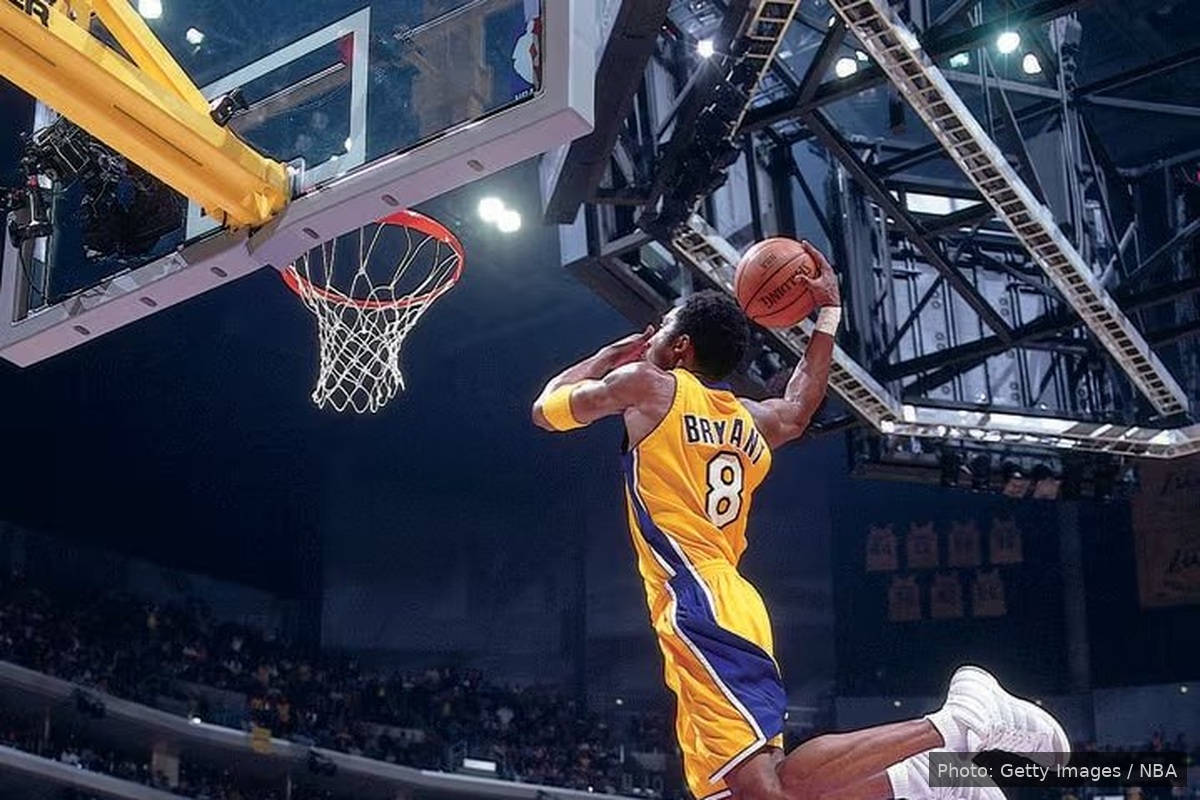
Kobe Bryant used to watch other players — not to be entertained, not to scout, but to steal.
He’d observe a move. Absorb it. Go home and do it a thousand times. Then make it his own.
He did this with Michael Jordan. With Hakeem Olajuwon. With European players nobody else in the NBA was watching. He once studied soccer players — not for footwork drills — but to understand how elite athletes move without the ball. He pulled from everywhere. He learned from everyone.
That wasn’t just a basketball habit. That was a life habit. And it’s the single biggest reason Kobe became Kobe.
Not the genetics. Not the early access. Not even the obsessive work ethic — though that was real too.
It was the learning.
The Skill Nobody Talks About
Every coach talks about work ethic. Every trainer talks about reps. Every recruiting profile talks about athleticism and length and motor.
Nobody talks about learning rate.
Here’s the truth: two players can put in the exact same hours and end up in completely different places five years later. The difference isn’t effort. It’s what they absorbed along the way.
The player who learns faster compounds. Every practice, every game, every conversation with a coach or veteran becomes a deposit. Over time, the gap between a learner and a non-learner becomes impossible to close — not because the learner is more gifted, but because they’ve been collecting while everyone else has been just showing up.
And here’s what most people miss: learning is a skill. And it’s a choice.
You weren’t born a great learner or a poor one. You decide — every single day, every single rep — whether you’re going to absorb what’s in front of you or let it pass. That decision, made consistently over months and years, is what separates players who plateau from players who keep climbing.
This isn’t just basketball. The best doctors keep learning when they’re already great. The best leaders still ask questions when they have all the authority. The best parents admit when they got it wrong and adjust. Learning posture — the choice to stay open, curious, and hungry — is the trait that determines how far you go in every room you ever walk into.
Feedback Is a Gift — And Most People Return It
Here’s the hardest part. When most of us get feedback, our first instinct is defense.
A coach pulls you aside and says your footwork is off. Your brain fires: He’s criticizing me. She thinks I’m not good enough. They don’t believe in me. You explain. You justify. You shut down just enough that the next note doesn’t fully land.
That’s a completely natural response. It’s also the response that will quietly cap your ceiling.
Think about what feedback actually is: someone investing their attention in your growth. They watched closely enough to see what you can’t see about yourself. They cared enough to say something out loud. Most people around you — opponents, strangers, even some coaches — won’t bother. They’ll just watch you stay stuck.
When someone gives you feedback, they’re not judging you. They’re betting on you. The question is whether you’re brave enough to receive it.
Knowledge is power — but only if you’re willing to acquire it. Every correction you receive is knowledge. Every honest conversation with a coach is knowledge. Every time you watch film and see a mistake you made, that’s knowledge. The player who collects that knowledge and acts on it is building something. The player who deflects it is burning it.
Kobe’s Loop — And How to Use It
Kobe never called it a system. But watching how he operated, the pattern is clear. Four steps, repeated endlessly:
Observe. Watch everything. Watch the best players. Watch players you’ve never heard of. Watch how your coach teaches the player next to you — because that lesson is available to you too. Kobe watched how musicians practiced. How surgeons prepared. How athletes in completely different sports used their bodies. He treated the whole world as a classroom, because it is.
Steal. When you see something that works, take it. Not copying — absorbing. There’s no shame in learning a move from an opponent, a leadership approach from a veteran, a habit from someone twice your age. The best learners are shameless thieves of what works. Kobe was the most elegant thief in NBA history.
Apply. This is where most people stop. They understand something intellectually but never test it under pressure. Kobe didn’t just study Hakeem’s footwork on film — he drilled it until it was muscle memory, until it was his. Learning without application is just entertainment. The loop doesn’t close until you’ve tried it.
Reflect. This is the step almost everyone skips. After the practice, after the game, after the coach’s note — what did you actually learn? What worked? What didn’t? What would you do differently? The players who sit with that question, who write it down, who actually process the experience — they own it. Everyone else forgets it by morning.
That loop — Observe, Steal, Apply, Reflect — is available to every player, every day. It costs nothing. It doesn’t require elite coaching or a top-tier facility. It just requires the decision to be a learner.
The Proof Is Everywhere Right Now
You don’t have to look back at Kobe to find this. Watch any locker room today and you’ll spot who the learners are within five minutes.
Derrick White went undrafted. Nobody handed him anything. What he had — and has — is an obsessive commitment to studying the game. He watched film with the urgency of someone who knew he couldn’t afford to miss anything. He took every coach’s note seriously. He turned feedback into fuel. Now he’s one of the smartest, most complete players in the NBA. Knowledge did that.
Cooper Flagg walked into an NBA locker room as a teenager surrounded by veterans who’d been in the league longer than he’d been in high school. His instinct wasn’t to prove himself immediately. It was to listen. To absorb. To make it obvious he was there to learn, not just to perform. That learning posture — at 18 years old, in one of the most pressure-filled environments on earth — is extraordinary. It’s also a choice he makes every day.
Amen Thompson had to learn two things simultaneously: how to be a professional, and how to grow into a leader. Two completely different curricula. What made both possible was staying open — taking feedback on his game and on how he was showing up for his teammates. That kind of dual-track learning is rare. It comes from someone who genuinely believes that every piece of information makes him better. Because it does.
What This Looks Like For You — On a Regular Tuesday
Inspiration is easy. Habits are where it gets real. Here’s what the learning loop looks like on a regular Tuesday when nothing special is happening:
Before practice: Watch five minutes of a player who plays your position at a higher level. One specific thing — how they move without the ball, how they set their feet, how they communicate. Just one thing to carry into the gym.
During practice: When a coach gives you a correction, resist the urge to explain or justify. Just say “got it” and try it. Not forever — just this rep. See what happens. Coachability isn’t blind agreement. It’s the willingness to try before you judge.
After practice: Ask one specific question. Not “how’d I do?” — that’s approval-seeking. Ask: “What’s the one thing I could clean up that would make the biggest difference?” That question signals you’re a learner. Coaches notice players who ask it. They remember them.
At night: Write it down. Three lines. What I worked on. What I noticed. What I want to try tomorrow. Small enough to actually do. Consistent enough to compound. This is exactly what the Legacy Basketball Journal was built for — making the reflect step a daily habit instead of an occasional good intention.
This Is Bigger Than Basketball
Here’s what nobody told you: the learning habit you build on the court is the same one that will determine how far you go in everything else.
The teenager who learns to receive feedback without shutting down is the same person who will thrive when a boss tells them their work needs improvement. The player who watches veterans to understand how professionals carry themselves is the same one who will walk into a job interview and immediately read the room. The athlete who writes down what they observed is building the reflective practice that leaders, entrepreneurs, and great parents use every day.
You’re not just learning basketball. You’re learning how to learn.
Knowledge is power — not as a poster quote, but as a daily operating principle. Every piece of information you collect about your game, your habits, your strengths, your blind spots is a competitive advantage. Not just in sports. In life.
Kobe understood this better than almost anyone. He didn’t just become a great basketball player. He became a storyteller, a business builder, a father who thought deeply about how to pass his mindset to his daughters. The same learning engine that made him Kobe on the court made him who he was in every other room he walked into.
That engine is available to you right now. The question is whether you’ll choose to turn it on.
The most coachable player in the room isn’t the one who never pushes back. It’s the one who never stops asking. Never stops watching. Never stops trying to understand what they don’t yet know.
Feedback isn’t criticism. It’s a gift. Learning isn’t passive. It’s a skill you build and a choice you make.
Observe. Steal. Apply. Reflect. Repeat.
That’s what Kobe knew.
📓 Legacy Basketball Journal
The Reflect step is where learning becomes yours. The Legacy Basketball Journal gives you a daily structure to track what you’re working on, what you’re noticing, and where you’re growing — on and off the court. Build the habit. Own the skill.
🃏 HoopWrld Performance Cards
Skills. Strength. IQ. Recovery. Mindset. A structured daily training system built on fundamentals — because knowing what to work on and actually working on it are two different things. This is the Apply step, made real.
📚 Go Deeper — Kobe’s Books
Kobe didn’t just play the game — he wrote about how he thought about it. These books are the closest thing to learning directly from him. If the Observe → Steal → Apply → Reflect loop resonated with you, start here.
The Mamba Mentality: How I Play
Kobe’s own breakdown of how he prepared, studied opponents, and approached every single game. Essential reading for any serious player.
The Wizenard Series: Training Camp
Kobe’s story for young athletes — a team, a magical coach, and the mental and emotional work required to become your best. Perfect for teen hoopers.
The Wizenard Series: Season One
The follow-up to Training Camp — sacrifice, supernatural breakthroughs, and supreme dedication. A #1 NYT Bestseller built for young athletes aged 10–18.
* As an Amazon Associate, HoopWrld earns from qualifying purchases. This helps us keep creating free content for the basketball community.
Keywords: Kobe Bryant learning mindset, basketball player development, coachability, feedback is a gift, learning is a skill, Derrick White, Cooper Flagg, Amen Thompson, teen athlete mindset, knowledge is power basketball, Legacy Basketball Journal, HoopWrld Performance Cards